Published Date-30th January 2026
Cybersecurity is no longer just an IT concern; it is a critical business risk. As we step into 2026, companies are becoming more digital, distributed, and data-driven than ever before, and cyber threats are evolving just as quickly. What once seemed like isolated attacks on large enterprises is now a daily reality for startups, mid-sized businesses, and global organizations alike.
In the coming year, cybersecurity threats are expected to become more targeted, automated, and harder to detect. Attackers will not only exploit technical vulnerabilities but also take advantage of human behaviour, weak processes, and blind spots created by rapid digital adoption. As 2026 approaches, understanding these risks early will be essential for building stronger defences and ensuring long-term business resilience.
Strong cybersecurity today is the foundation for a safer and more resilient business tomorrow
Artificial intelligence is transforming cybersecurity, but not just for defenders. Attackers are increasingly using AI to automate and enhance their attacks. In 2026, phishing emails will look more convincing than ever, written in perfect language, personalized using publicly available data, and timed precisely to catch employees off guard.
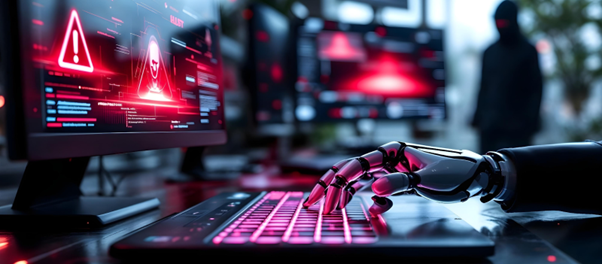
Awareness is the first step toward stronger digital protection
AI-driven malware can adapt its behaviour to avoid detection, making traditional security tools less effective. Instead of repeating the same attack patterns, these threats can change in real time, learning from failed attempts and exploiting new vulnerabilities quickly. For businesses, this means relying solely on signature-based security is no longer enough. Proactive monitoring and behaviour-based detection will become essential.
Ransomware is evolving beyond simple data encryption. In 2026, attackers are expected to focus more on operational disruption. Instead of just locking files, ransomware groups may target critical systems, supply chains, or customer-facing platforms, bringing entire operations to a halt.
What makes modern ransomware especially dangerous is the rise of double and triple extortion tactics. Attackers don’t just demand payment to restore access, they threaten to leak sensitive data, notify customers, or even disrupt partners. This puts businesses under immense pressure, often forcing quick decisions that can have long-term consequences.
The best defense is not just backups, but strong incident response planning, network segmentation, and employee awareness.
Businesses today rely on dozens, sometimes hundreds, of third-party vendors, tools, and platforms. Each of these connections represents a potential entry point for attackers. In 2026, supply chain attacks are expected to increase as hackers target smaller, less-secure vendors to reach larger organizations.
These attacks are particularly dangerous because they often go unnoticed for long periods. A trusted software update or integration can carry malicious code, spreading the attack across multiple organizations at once. For businesses, this highlights the importance of vendor risk assessments, continuous monitoring, and clear security standards for partners.
Not all cyber threats come from outside the organization. Insider threats, whether malicious or accidental, continue to be a major risk. As remote and hybrid work models persist, monitoring user behaviour becomes more complex.
In 2026, insider threats will be harder to detect because they often blend in with normal activity. A compromised employee account, excessive access privileges, or simple human error can lead to serious breaches. Businesses need to move beyond basic access controls and adopt zero-trust principles, ensuring that access is continuously verified rather than assumed.
Cloud adoption has brought speed and scalability, but it has also introduced new risks. Many breaches are not caused by sophisticated hacking, but by simple misconfigurations, open storage buckets, weak access controls, or poorly managed identities.
Smart monitoring improves overall protection
As businesses expand their cloud infrastructure in 2026, the complexity of managing multiple environments increases. Without proper governance and visibility, misconfigurations can go unnoticed until data is exposed or systems are compromised. Regular audits, automated configuration checks, and cloud security best practices will be critical.
Passwords alone are no longer enough. In 2026, identity-based attacks such as credential stuffing, account takeover, and session hijacking are expected to rise sharply. Attackers know that identities are often the weakest link in security.
With employees accessing systems from multiple devices and locations, stolen credentials can provide attackers with broad access. Multi-factor authentication, strong identity management, and continuous authentication will play a key role in reducing this risk. Businesses must treat identity as a core security perimeter, not an afterthought.
Software design plays a significant role in infrastructure sustainability. Inefficient applications consume excessive processing power, memory, and storage. This increases energy usage and hardware demand. Modern software development focuses on performance optimization, lightweight architecture, and efficient coding practices. Cloud-native applications are designed to scale dynamically, using resources only when required. AI-powered monitoring tools analyze software behavior and recommend improvements to reduce resource consumption. By prioritizing efficient software, organizations can achieve sustainability goals more effectively.
From smart offices to connected manufacturing systems, Internet of Things (IoT) devices are becoming more common in business environments. While these devices improve efficiency, they often lack strong security controls.
In 2026, insecure IoT devices could become easy targets for attackers looking to move laterally across networks or launch large-scale attacks. Businesses need clear policies for device management, regular updates, and network segmentation to limit potential damage.
Cybersecurity threats are not just technical risks, they are legal and reputational ones too. Governments around the world are introducing stricter data protection and cybersecurity regulations. In 2026, non-compliance could lead to heavy fines, legal action, and loss of customer trust.
Businesses must ensure that their cybersecurity strategies align with regulatory requirements. This includes data protection, incident reporting, and transparency. Compliance should be seen as a baseline, not the end goal.
Despite all technological advances, humans remain the most targeted attack vector. Social engineering attacks exploit trust, urgency, and lack of awareness. Even the most secure systems can be compromised by a single click.
In 2026, cybersecurity training will be just as important as technical defences. Employees need to understand not just what to do, but why it matters. Building a security-aware culture is one of the most effective ways to reduce risk.

Many cyber-attacks begin with simple human errors.
The future of cybersecurity is not about eliminating risk, it’s about managing it intelligently. Businesses that succeed will adopt a layered approach, combining technology, processes, and people to achieve their goals. Continuous monitoring, regular assessments, and proactive planning will be key.
Cybersecurity should be embedded into business strategy, not treated as an afterthought. When leaders understand the risks and invest in resilience, organizations are better prepared to face whatever threats emerge next.

AI-powered attacks and ransomware-driven business disruption are expected to be among the most significant threats.
Yes. Small and mid-sized businesses are often targeted because they have fewer security resources and weaker defenses.
By investing in employee training, strong identity management, proactive monitoring, and incident response planning.
No. While technology is essential, human awareness and strong processes are equally important.
Because cyber incidents can impact operations, finances, reputation, and customer trust, not just IT systems.